Matt Drinkall cuts diss track on CFP expansion to 24 teams, corporatization of college football
Drinkall didn't hold back when asked about his thoughts on the latest turn for college football's postseason.
Mitten Football is a reader supported publication aiming to bring independent coverage of FBS college football in Michigan, with a particular focus on the Michigan MAC teams. Considering subscribing for $8 a month ($87 a year) to support this work. And consider sharing Mitten Football — referrals from trusted sources are the strongest endorsement.
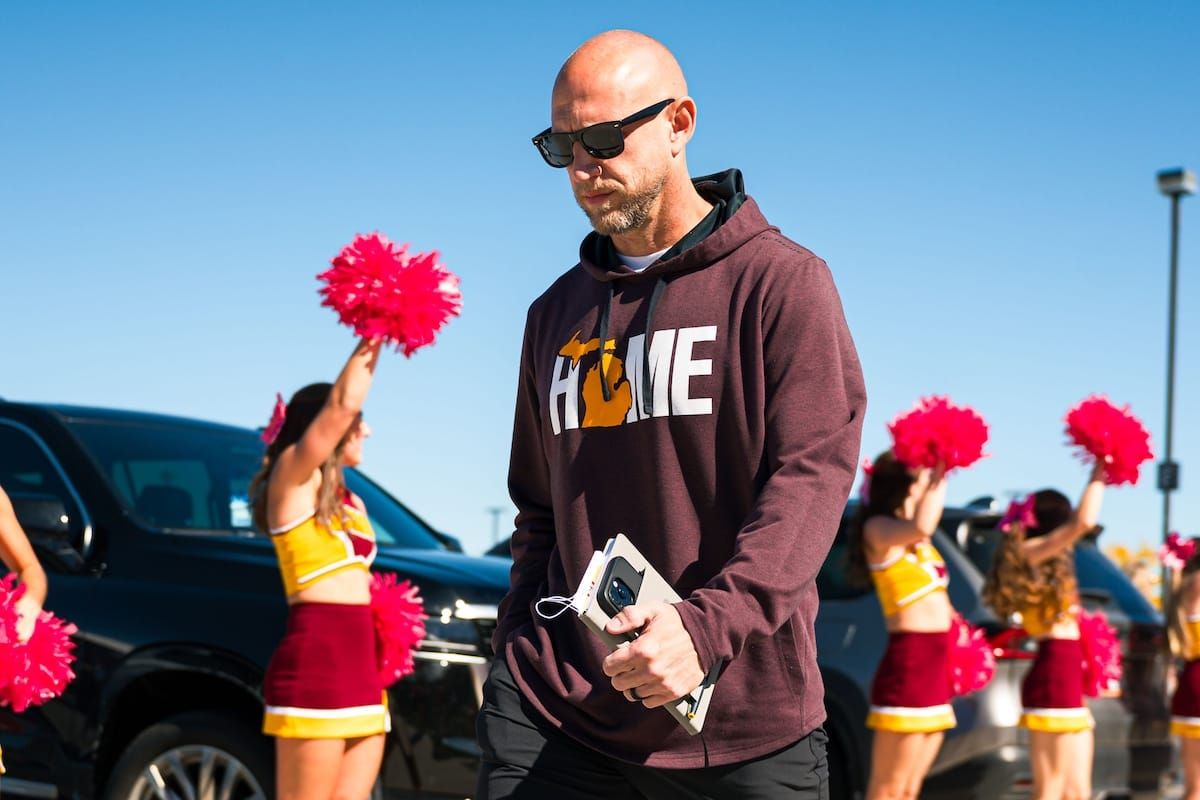
If anyone associated with the College Football Playoff power structure is looking for a Group of 6 head coach to help manufacture some consent, they’ll be leaving Central Michigan’s Matt Drinkall off their call sheets.
Asked about the impending expansion to 24 teams for the CFP, seemingly inevitably coming next fall, Drinkall shot back with a simple question: How long would the reports on his weekly media zoom like him to answer?
Then he spent the next 10 minutes dressing down the machinations and motives behind college football’s frog march from the pre-BCS era to now, on the cusp of a 24-team playoff field come next fall. He indicted those in charge of the power conferences, television networks and big-brand universities for overseeing what he views as the dilution and destruction of college football as so many of us have known it, a vibrant, tradition-rich tapestry. His preferred d-word might go further: Desecration.
And above all else, Drinkall sees it all as deeply reactionary and lacking foresight.
“But one of my biggest concerns with it is, I feel like, everybody keeps asking — everything is reactionary,” Drinkall said. “All of everything since COVID has just 100 percent been reactionary. No one has ever said, 'OK, well, if we do this, what does it look like 15 years from now? What does this look like 10 years from now? Is this in the best interest culturally of everyone?' Or is it all just, 'How do I save my ass and make the most money right this second right now?' Which is what everyone's gonna do. Whoever has to sell TV spots or tickets at every school or promote a conference, they're not interested in what's good for the sport of football. They're not interested in what's good for young people coming up. And they want to know 'What makes my job the most amount of money right now.' So everything since COVID, all reactionary.”
Drinkall ran through a number of concerns and complaints that have already been well-worn in public: Dilution of the regular season when power conference teams can get in while losing every third week, the token treatment of the Group of 6 and its lone spot, and the fact this is largely about the two 900 pound gorillas of college football, the Big Ten and the SEC (and by proxy Fox and ESPN) doing what they want for them, and reverse-engineering a case as to why further playoff expansion is good.
He likened it to the advent of the BCS system, something he'd recently read about in "Death to the BCS:" the 2011 revised edition from Dan Wetzel, Josh Peter and Jeff Passan, which took to task a system that was not particularly honest about how or why it came to be, or actually functioned in picking who got to play for a national title.
That book calls the power structure of college football a cartel serving its interests and not that of the sport, and Drinkall sees the echoes of that history now — even as a junior partner in the cartel himself, as a sitting FBS head coach.
"Sold a bill of goods," Drinkall said of the BCS. "And now it's, you know, the four team playoff, and it was only four. Man, it was 12. Now it's 24. Man, just like the NCAA basketball tournament, and 'It's only one more play in game. Just kidding. Now we're letting everybody in. The whole thing's a tournament. Just gamble on all of it, promote all of it on TV. As long as we make money, who gives a shit? Who cares what happens to these kids?' Their lives get torn apart, transferred 500 times, people abuse them, people take advantage of them, IRS is gonna come destroy these guys' lives in five or six years. It's a complete cultural disaster to be teaching no skills that are gonna be replicable or applicable towards the rest of their lives. 'Who cares!? We're gonna sell some more tickets and more clicks this weekend. And that's the only thing we give a shit about today.' So that's what's getting ready to happen with the 24-team playoff as far as my two cents. It's gonna make this, gonna make whoever, a bunch of money. Everybody's gonna watch for a while. When it starts to lose its luster, whatever that looks like, they're gonna change it again. And tell us it's in the best interests of everybody."
Drinkall's full, unabridged comments on 24-team playoff
WHAT IS YOUR GENERAL TAKE ON THE 24 TEAM PLAYOFF? (J.H. Jimenez, ByTheBelt)
How long would you like me to answer? I will be very honest with you about all of this. So how long would you like me to answer?
TAKE YOUR TIME (J.H. Jimenez, ByTheBelt)
I think it's going to generate a ton of revenue for the powers that be. I think it's going to be — it is going to be the last threshold that pushes a certain percentage of college football into the professional football realm forever. I think this is going to lead to a lessening of the regular season. I can talk to you, I know, like, the product right now in college football, there's more perceived parity. Um, but it's, in my opinion, it's not that everything is, like, it's better and all greased up. I think the product isn't as good. And it's not as cool. So if you look at, like, who loves college football, everybody other than the people working it usually, right now. Like the model of it, the business model of it, like, the people working in it right now is incredibly challenging and frustrating, because you're trying to, you basically have a whole world of fan bases that want it, like, how college football used to be. That is not how this is going to be moving forward. If they move to this, it will separate Power 4 football into its own separate thing of Division I football. I mean, whether you call everybody FBS or not, you can call them whenever you want. It's going to separate that group into a completely different league. It is going to make the regular season absolutely matter less in several regards. There's — they're gonna see multiple regular season losses, which, in some places, like the Cinderella seasons, and seasons that go on that really help boost enrollment, and engagement, ticket sales during the course of the season, you'll see all that stuff start to dwindle after the initial flow of the TV money. I do think it's only a matter of time, that as soon as they do this, this is the precursor to whoever's gonna be able to empty — they'll take the Power 4s, they will take one Group of 6 teams as a carrot to dangle in front of everybody. But the reality is, is that it's a money-making machine for the Power 4 conferences, that the powers that be want to push everybody to watch. So the regular season will matter less. Schools, especially at premier schools, will want to — have no incentive whatsoever to schedule anyone challenging outside of, nonconference, that will virtually end. Let's see. Yeah, like, everybody, I think a lot of the — I'm not in the meetings, obviously a lot smarter people than me in it.
But one of my biggest concerns with it is, I feel like, everybody keeps asking — everything is reactionary. All of everything since COVID has just 100 percent been reactionary. No one has ever said, 'OK, well, if we do this, what does it look like 15 years from now? What does this look like 10 years from now? Is this in the best interest culturally of everyone?' Or is it all just, 'How do I save my ass and make the most money right this second right now?' Which is what everyone's gonna do. Whoever has to sell TV spots or tickets at every school or promote a conference, they're not interested in what's good for the sport of football. They're not interested in what's good for young people coming up. And they want to know 'What makes my job the most amount of money right now.' So everything since COVID, all reactionary. Conference realignment, eligibility, paying players, transfer policies, none of it's good. None of it is in the best interests of the student athlete. None of it's in the best interests of the sport. It's just like everybody went nuts at once, and it's just been a downward spiral that is nonstop until it's going to be a smoldering dumpster fire left. Like, the Truffula trees in the Lorax. Like, they're gonna wring this sport out for every cent they can, as long as they can, and prostitute the sport for financial gain until people stop caring. Just like they did with boxing back in the '20s. Major League Baseball back when they'd sell all these fields out. They're going to prostitute it as much as they can, as possible. Until people stop caring.
So, the big thing, the only thing I can't forecast, I don't know what's gonna happen, is, once they do this, which they're gonna, 'cause it's gonna make them a bunch of money, when they do this, the schools that are in the playoffs all the time, and are making the financial and physical resource contribution to be in that group. It's only gonna take them a little bit of more time to figure out, 'Hey, I like all this money. Why am I giving some of this back to the NCAA? Why am I sharing this with all these other sports? You know what we're gonna do. Let's just leave. Why don't we do that? Why don't we just not give the NCAA anything?' So, the Big Ten and the SEC with their NIL, the contracts they're signed, like, the conferences, obviously, have demonstrated that they have more powers in conference than any NCAA institution does in a court of law. So the NCAA can't force anything. So, as soon as all this money starts coming in, right, let me tell you something, if I was one of these schools, you were giving me a bunch of money, and I just had to hand it out to other people for no reason, at some point, I'd go, 'How do I make this so I don't have to hand any of this away to you guys? OK, I'm gonna do that.' So that's what's coming next. So, it's just a matter of how fast.
So, like they did the BCS to us — Andrew knows what I'm talking about — sold a bill of goods, and now it's, you know, the four team playoff, and it was only four. Man, it was 12. Now it's 24. Man, just like the NCAA basketball tournament. And it's only one more play in game. Just kidding. Now we're letting everybody in, the whole thing's a tournament, just gamble on all of it, promote all of it on TV. As long as we make money, who gives a shit? Who cares what happens to these kids? Their lives get torn apart, transferred 500 times, people abuse them, people take advantage of them, IRS is gonna come destroy these guys' lives in five or six years. It's a complete cultural disaster to be teaching no skills that are gonna be replicable or applicable towards the rest of their lives. Who cares!? We're gonna sell some more tickets and more clicks this weekend. And that's the only thing we give a shit about today. So that's what's getting ready to happen with the 24-team playoff as far as my two cents. It's gonna make this, gonna make whoever, a bunch of money. Everybody's gonna watch for a while. When it starts to lose its luster, whatever that looks like, they're gonna change it again. And tell us it's in the best interests of everybody.
FEEL LIKE THERE SHOULD BE AN APPLAUSE BREAK FOR THAT BEING OFF THE CUFF (Andrew Graham, Mitten Football)
WAS ANTICIPATING SOME ANSWER ON THOSE LINES (J.H. Jimenez, ByTheBelt)
It's just, it's insane, you know what I mean? Like, and then they, like, they don't make — no offense to anybody there, but it's, like, you can't do this and have one team not be in a conference, and they don't have to share their money with any, like, I mean, you can do it. You absolutely can do it. They're doing it right now. You absolutely can. So, I don't know what I'm talking about, they can do whatever they want from now on, and they can, and no one will stop them. We're all gonna complain into the abyss for nothing, and they're gonna do it anyway. That's how it's gonna work. So if 24 teams makes them more money, that's what they're gonna do. And the rest of us are gonna talk about it on podcasts, and this stuff, and then nothing will change. And when they get, they find a new way to make more money, they'll change it again. Until the sport implodes on itself.
WHAT ABOUT A G6 PLAYOFF THEN? (J.H. Jimenez, ByTheBelt)
I mean, then you're, you can call it, again — it's just FCS football. What FCS football was. There's the top tier, and then there's the next tier. As soon as you start changing how postseason play works, that, to me, is a bigger change of levels of football than even scholarships or resources now. I mean, it used to be like, 'Hey, 85 full scholarships, go to bowls.' That was everybody who was in FBS. You were FCS, you had 63 scholarships. You break up amongst 85 guys, go play in a playoff. Totally separate. What middle Tennessee State could do was the exact same as Georgia. We all had 85 scholarships, we all had the exact same rules. We all had the exact same post season, everything. Everything was the same. As close as you could be. Now, was it all in reality? No, Middle Tennessee State goes and builds a stadium, and Alabama goes and builds their stadium, Georgia, or whoever, that part is different. But as far as your ability to get players and keep them, and coach them, and develop, and build rosters, that part was all very, very comparable. So, to me, when you make that shift, you say 'You're not all playing for the same, it's just a different classification.' So even now, you can call it Power 4. It's not what it is. There's a Power 2, and then the other Power 2. Not a Power 4. When all — watch, when the bowls and all those get done, play this clip again: ACC, and Big 12 aren't gonna have the same money payout games as the Big Ten in the SEC. It's not how it's gonna work. It's not really the Power 4. It's the Power 2. But it's like — I just, we get gaslit pretty hard into believing what we have to, to justify changing what they need to make money. So, I get it a lot better now.
And that naked might-is-right mode of self-interested decision making from the power conferences and leaders driving this move seems to be at the heart of Drinkall’s ire.
Drinkall cited the common complaint that this decision is about the Power 4 conferences — and really the Power 2, as he singled out the reality that the ACC and Big 12 are getting marginalized, too, in some capacity — making more money. In general, the expanded playoff format won’t make a whole lot more money for the power leagues or teams, based on various reporting, as the new revenues offset what might be lost from the scuttling of conference championship weekend with an amended season schedule.
But while dollars and cents coming in may not have triggered this decision, Drinkall is probably directionally right about this move being to protect futures for coaches and roster investments for patrons at schools in the SEC and Big Ten, so as to avoid a high-priced roster costing a booster money for no playoff and, ergo, a coach their job.
Drinkall also cited the absurdity of a system where 136 schools are part of conferences that do various forms of intra-league revenue sharing while two teams, and most specifically Notre Dame (UConn is the other indy team), get a different financial model but the same CFP outlook.
“They can do whatever they want from now on, and they can, and no one will stop them,” Drinkall said of the power conferences and schools and powers that be in college football. “We're all gonna complain into the abyss for nothing, and they're gonna do it anyway. That's how it's gonna work. So if 24 teams makes them more money, that's what they're gonna do. And the rest of us are gonna talk about it on podcasts, and this stuff, and then nothing will change. And when they get, when they find a new way to make more money, they'll change it again. Until the sport implodes on itself.”
(Editor’s note: Why the MAC needs to forgo a championship game just because that weekend has been scrubbed for a playoff, one the league is seemingly being squeezed out of, is in and of itself a nonsensical feature of the new format.)
And more generally, Drinkall’s ire seems to stem from a place deeper and broader than the expansion of the playoff, but having to do with the increasingly-corporatized nature of college football, where programs are judged just as much on a ledger as they are by wins, losses and the cultural and campus impact they can have.
A sport built on tradition is, increasingly, as Drinkall sees it, being run on transaction. And a sport where the rules were set up to create some parity in resources and roster building — Alabama had 85 scholarships, the same as Central Michigan — has been foregone for one where the money that, say, Alabama would use on facilities to outpace others in recruiting, is just being directly paid out to recruits and players.
And given that the “cap” created by the House settlement has been ignored and largely unenforceable as college football rosters are hurtling towards costing $100 million in the coming years, the current system is one where, despite playing in the same division and for the same prizes, Alabama and Central Michigan are not playing the same game as programs off the field.
“Conference realignment, eligibility, paying players, transfer policies, none of it's good, none of it is in the best interests of the student athlete,” Drinkall said. “None of it's in the best interests of the sport. It's just like everybody went nuts at once, and it's just been a downward spiral that is nonstop until it's going to be a smoldering dumpster fire left. Like the Truffula trees in the Lorax. Like, they're gonna wring this sport out for every cent they can, as long as they can, and prostitute the sport for financial gain until people stop caring. Just like they did with boxing back in the '20s. Major League Baseball back when they'd sell all these fields out. They're going to prostitute it as much as they can, as possible. Until people stop caring.”
And Drinkall ultimately predicts the 24-team playoff, one that will be a palooza of power conference teams with the “carrot” of one G6 spot, may be something of a Trojan horse for the powerhouse, monied programs who keep competing in the CFP to turn around and ask why they’re sharing money to fund the likes of Maryland, Vanderbilt or, to some degree, Central Michigan.
Eventually he sees the bifurcation coming, with the haves playing for a 24-team CFP cutting their ranks down to avoid sharing the gains of TV revenues from a 23-game postseason.
And the end stakes, as Drinkall laid it out, is basically half of FBS getting sawed off and being, in effect, what the FCS once was, playing with less resources in their own postseason.
“We get gaslit pretty hard into believing what we have to, to justify changing what they need to make money,” Drinkall said.